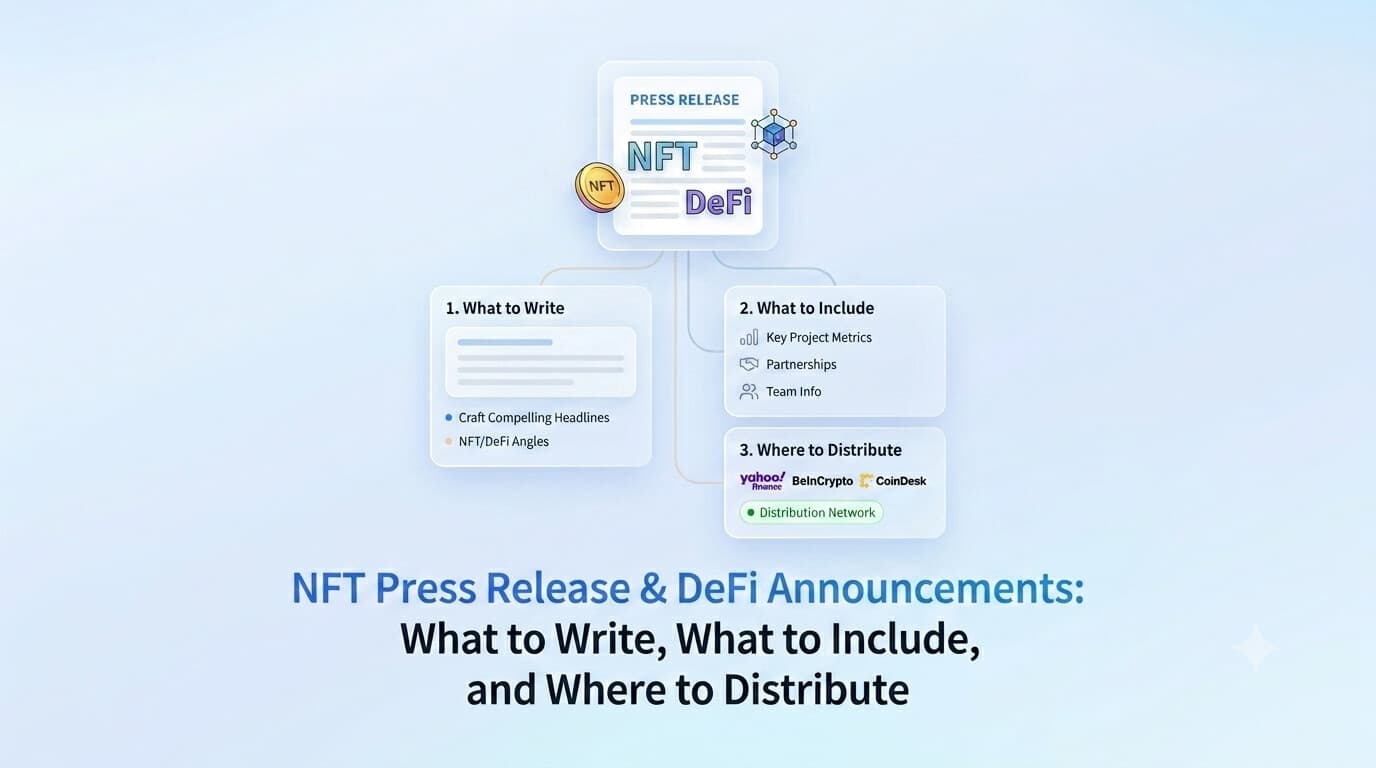
An NFT press release is a formal announcement distributed to crypto and mainstream media to inform investors, collectors, and journalists about an NFT collection launch, mint details, utility, and team credentials. A DeFi press release does the same for protocol launches, TVL milestones, and token generation events. Both build verifiable credibility that no Discord update or tweet thread can replicate.
The difference comes down to audience, required content, and what "newsworthy" means for each announcement type.
Key Highlights:
The global NFT market is projected to reach $60.82 billion by 2026, up from $43.08 billion in 2025. (Source: Business Research Company, 2026)
The DeFi market was valued at $26.94 billion in 2025 and is forecast to reach $37.27 billion in 2026, growing at a CAGR of 68.2%. (Source: NFTPlazas Research, 2026)
NFT and DeFi press releases sent Tuesday through Thursday, 9am-1pm EST, consistently generate the highest journalist pickup rates.
Announce Chain delivers guaranteed placements on CoinTelegraph, CoinDesk, Yahoo Finance, and AP News with live verified URLs in 48 hours.
What Are NFT and DeFi Press Releases?
A Web3 press release is a structured, newsworthy announcement distributed to crypto media, financial publications, and news wires to earn coverage for a blockchain project.
It is not a blog post, a Discord update, or a thread on X. It is a document journalists and editors can verify, publish, and index permanently.
NFT and DeFi press releases follow the same AP-style structure as any professional news release. What makes them distinct is the audience, required content, and editorial standards of the outlets they target.
A social media post disappears in hours. A press release indexed on Yahoo Finance or CoinTelegraph stays searchable for years, generating backlinks and investor trust long after the distribution date.
NFT Press Release vs DeFi Press Release vs Web3 Press Release
Factor | NFT Press Release | DeFi Press Release | Web3 Press Release |
Primary audience | Collectors, investors, community | Institutional investors, liquidity providers, developers | Broad Web3 stakeholders |
Core content | Supply, mint price, rarity, utility | Tokenomics, audit, TVL, APY, governance | Varies by milestone |
News hook | Drop date, reveal, partnership | Protocol launch, upgrade, funding | Token listing, mainnet |
Target outlets | CoinTelegraph, Decrypt, NFT Plazas | CoinDesk, The Block, Bloomberg | AP News, Yahoo Finance, Benzinga |
Tone | Story-driven, community-focused | Data-driven, technical, institutional | Balanced |
Compliance risk | Low to moderate | High (avoid investment language) | Moderate |
Timing | 7-10 days pre-drop | Aligned with launch or upgrade | Event-specific |
How NFT and DeFi Announcements Work?
Both follow the same five-step process. The execution differs. The architecture does not.
Step 1: Define what is actually newsworthy
A 10,000 PFP collection with no utility is not news in 2026. A protocol upgrade that pushed TVL past $40M with a completed audit is. If you cannot answer "why would a crypto journalist care about this today," rethink the angle before writing anything.
Step 2: Build the right content for your announcement type
NFT releases need mint details, rarity breakdown, and an artist or utility narrative. DeFi releases need tokenomics, audit confirmation, APY data, and a founder quote about ecosystem contribution, not return projections.
Step 3: Write in AP style
Lead with who, what, when, where, why in the first two to three sentences. One named executive quote after the lead. Named statistics with sources inline. Boilerplate in four to five sentences.
Put your next announcement in front of the right audience
Announce Chain distributes to CoinTelegraph, CoinDesk, Yahoo Finance, and AP News with guaranteed placement and live URLs in 48 hours.
Step 4: Distribute to both crypto-native and mainstream outlets
CoinDesk and CoinTelegraph reach investors, developers, and traders already in the space. Yahoo Finance and AP News reach institutional allocators and mainstream financial partners. A strong campaign needs both. Our crypto press release distribution page covers exactly how this works.
Step 5: Amplify through community channels post-distribution
When your release goes live on CoinTelegraph, share the indexed URL across Discord, Telegram, and X immediately. The press placement provides credibility. Community amplification determines how far it actually travels. These two work together, not separately.
See full guide on how all this comes together: How to Write a Press Release?
Is Your Announcement Actually News?
This is where most Web3 projects go wrong before they even open a document.
Journalists in 2026 filter NFT and DeFi pitches through one question: does this project solve a real problem, or is it another launch disguised as innovation? The post-hype editorial environment is unforgiving.
For NFT projects, what is newsworthy in 2026:
Real-world asset tokenization (property, luxury goods, collectibles)
Gaming integration with verifiable on-chain mechanics
IP licensing or brand collaboration with genuine creative involvement
Utility-backed collections with working products, not roadmap promises
What no longer gets coverage:
Generic PFP collections without innovation
Celebrity endorsements paid for promotion only
Vague metaverse promises without live product
Hype-first announcements with no verifiable traction data
For DeFi projects, what is newsworthy:
Protocol launches with completed smart contract audits from named firms
Funding rounds with named institutional investors
TVL milestones backed by on-chain data
Governance changes that materially affect token holders
Projects that lead with verifiable facts get published. Projects that lead with vision statements get deleted.
What Every NFT Press Release Must Include?
An NFT press release that lands in 2026 is built on specific, verifiable information. Editors have seen thousands of vague collection launches and stop reading at the first unsupported claim.
Collection fundamentals are non-negotiable: total supply, blockchain network, token standard (ERC-721, ERC-1155, or SPL for Solana), mint price, and mint date. Missing any of these signals an unprepared team to every editor who opens the file.
Utility and value proposition need to be specific. Gaming integration, DAO membership, royalty-sharing, real-world asset backing, and creator access are legitimate story angles. "Exclusive community access" without specifics is not a utility. It is a placeholder that collectors stopped believing years ago.
Rarity and structure matter to collectors making allocation decisions. How many tiers exist? What distinguishes rare traits? For generative collections, how was the rarity algorithm structured?
Team credentials and audit status are the trust signals that separate credible projects from noise. Who built this, what is their verifiable track record, and which firm audited the smart contract? In 2026, an unaudited contract is a PR liability, not a technicality.
One named executive quote, not three. A genuine insight about the project's place in the ecosystem, not a hype statement. Named. Titled. Standing behind it.
A single focused CTA to the mint page, whitepaper, or official website. Not five competing links. One action.
What Every DeFi Press Release Must Include?
DeFi audiences are more technically demanding than NFT collector communities. Institutional allocators and protocol developers read these releases differently. Vague claims get dismissed without a second thought.
Tokenomics transparency comes first. Token allocation model, emission schedule, vesting periods for team and investors, and how treasury funds are controlled. Institutional audiences check this before anything else, and a missing or unclear structure is a disqualifying signal.
Security audit confirmation needs a named firm, a completion date, and a link to the full public report. Certik, Trail of Bits, OpenZeppelin, and Halborn carry recognition. An unnamed or "in progress" audit creates doubt exactly where credibility matters most.
Protocol performance data must be verifiable. Current TVL, supported chains, APY for staking or liquidity provision, and daily transaction volume if available. Journalists and VCs treat claims without on-chain citations the same way they treat anonymous sources: as unverifiable noise.
Governance and compliance clarity protects both the project and the distribution channel. Describe how the protocol is governed, how upgrades are decided, and for token launches, describe utility and functionality only. Phrases like "guaranteed gains" or "price will increase" trigger editorial rejection at credible outlets and create securities-law exposure.
A founder quote focused on ecosystem contribution, not market movement. What problem does this protocol solve? What does it add that did not exist before? Keep it grounded in development and user value, not trading speculation.
In DeFi PR, the difference between getting picked up by The Block and getting deleted comes down to one thing: verifiable data. If you cannot back it up on-chain or with an audit link, do not put it in the release. -- K.K., Crypto PR Strategist, Announce Chain
Need help drafting a release that meets these standards?
Our PR writing service handles DeFi and NFT announcements from first draft to final distribution.
Common Mistakes That Get Web3 PRs Rejected
Most Web3 press releases that fail do not fail because the project is weak. They fail because the execution is wrong. These are the errors that consistently kill otherwise solid announcements.
Hype language over facts: Words like "revolutionary," "groundbreaking," and "next-gen" get deleted before a journalist finishes the headline. Crypto editors have seen thousands of these. Specific, verifiable claims win. Adjective-heavy copy loses.
Price predictions in DeFi releases: Any language suggesting expected token appreciation or investment returns triggers editorial rejection at credible outlets and creates securities-law exposure. Describe utility and functionality only.
Vague utility promises in NFT releases: "Exclusive access to our ecosystem" means nothing. Access to what? Starting when? Collectors have been burned too many times. Specifics are the only thing that builds trust in 2026.
No named executive quote: A quote attributed to "the team" tells journalists that no individual is standing behind the announcement. Every credible release has a named founder or technical lead with their actual title.
Distributing to irrelevant outlets: Sending an NFT drop announcement to the general business press without a crypto angle wastes the budget. Target outlets whose readership matches the audience you actually need to reach.
Uncited statistics: "The DeFi space is growing fast" is meaningless. "The DeFi market is forecast to grow from $26.94 billion in 2025 to $37.27 billion in 2026 at a CAGR of 68.2% (Source: NFTPlazas Research, 2026)" is a citable claim that earns credibility.
Missing dateline: Follow AP News format: CITY, Date. Omitting it signals amateur PR to every editor who opens the document.
NFT and DeFi PR Best Practices Checklist
Run this before submitting any Web3 announcement for distribution:
[ ] Headline under 100 characters, factual, includes project name and core announcement.
[ ] Lead paragraph answers who, what, when, where, why in two to three sentences.
[ ] All numerical claims cite a named source with year.
[ ] One named executive quote placed after the lead.
[ ] NFT release includes: supply, mint date, price, blockchain, utility, smart contract audit status.
[ ] DeFi release includes: tokenomics, audit firm, TVL data, governance structure, APY.
[ ] No investment return language or price predictions anywhere in the document.
[ ] Single focused CTA, not multiple competing links.
[ ] Boilerplate is four to five sentences, factual, consistent across all releases.
[ ] Contact information complete and accurate.
[ ] Distribution service is crypto-specialized with a named outlet list, not a generic wire.
Announce Chain's guaranteed distribution service covers every item on this list, with editorial review before any release goes out.
For financial sector or institutional-facing crypto projects, see how financial services press release distribution handles compliance-sensitive announcements.
Your next NFT drop or DeFi launch deserves more than a tweet thread.
Announce Chain handles writing, editorial review, and distribution so your announcement lands on CoinTelegraph, Yahoo Finance, and AP News with verified links.
Key Takeaways
An NFT press release works when it leads with verifiable specifics: supply, mint date, utility, audit status, and a named executive quote. Hype language gets it deleted.
A DeFi press release must include tokenomics, a named audit firm, TVL data, and governance details. No investment language, no price predictions, no exceptions.
Distribution to both crypto-native outlets and mainstream financial media is what creates the indexed public record that investors, exchanges, and journalists independently check.
Timing matters. NFT announcements need a seven-to-ten-day pre-drop window. DeFi releases should align with the actual launch or upgrade event window.
Earned media outlasts every paid placement. A release indexed on AP News generates backlinks and AI citations long after the campaign ends.
Ready to distribute your NFT or DeFi announcement?
Announce Chain gets your press release in front of the right investors, exchanges, and media. Guaranteed placement. Live URLs in 48 hours.
Distribute with Announce Chain
Frequently Asked Questions
What is an NFT press release?
An NFT press release is a formal announcement distributed to crypto media and financial outlets to inform collectors, investors, and journalists about a collection launch. It covers supply, mint details, utility, and smart contract audit status. Unlike a social post, it creates an indexed public record that exchanges and investors reference during due diligence.
What is a DeFi press release?
A DeFi press release is a structured announcement a decentralized finance protocol distributes to share a launch, upgrade, or milestone with institutional investors, developers, and media. It requires tokenomics, audit confirmation from a named firm, TVL data, and governance details. Regulatory compliance in the language is non-negotiable.
How is a DeFi press release different from an NFT press release?
The core difference is audience and content depth. NFT releases target collectors and focus on art, rarity, and utility mechanics. DeFi releases target institutional allocators and focus on tokenomics, security audits, and protocol performance. Tone, target outlets, and required detail level all differ significantly between the two.
Which media outlets cover NFT and DeFi announcements?
NFT announcements go to CoinTelegraph, Decrypt, NFT Plazas, BeInCrypto, and CryptoSlate. DeFi announcements with institutional weight go to CoinDesk, The Block, Bloomberg, and AP News. Announce Chain distributes across both tiers with confirmed placements and live URLs in 48 hours.
When should an NFT project send a press release?
Seven to ten days before mint date is the target window. It gives collectors time to prepare, journalists time to cover the story, and the community time to build anticipation. Tuesday through Thursday, 9am-1pm EST, consistently produces the highest journalist pickup rate.
How do you write a DeFi press release investors will actually trust?
Lead with verifiable data: named audit firm, current TVL, APY with a clear explanation, and tokenomics with vesting schedules. One founder quote addressing what the protocol adds to the ecosystem. No language implying investment returns. Investors skip releases without data and delete anything that reads like a pitch deck.
Does an NFT or DeFi press release help with SEO?
Yes. Placements on CoinTelegraph, Yahoo Finance, and AP News generate high-authority backlinks that strengthen branded search rankings. Coverage also gets indexed by ChatGPT, Perplexity, and Google AI Overview. See how our crypto press release distribution is built for both traditional search and AI discovery.
How much does Web3 press release distribution cost?
Entry-level crypto-only distribution starts around $200-$400. Premium coverage including Yahoo Finance, AP News, and CoinTelegraph runs $1,000-$5,000 per release. For ecommerce or multi-sector Web3 brands, ecommerce press release distribution offers relevant cross-sector packages.
Can a small NFT or DeFi project afford professional distribution?
Yes, and the more relevant question is whether you can afford not to. Projects without indexed media coverage on credible outlets regularly fail exchange listing checks and institutional due diligence. Entry-level packages still reach crypto-native outlets that matter to your earliest community.
What makes a token launch announcement newsworthy to journalists?
Named institutional investors, a completed audit from a recognized firm, specific utility that did not exist before, and on-chain data to back every claim. A token launch without any of these is not a story. A token launch with all of them placed in the first paragraph gets read. For energy and industrial-sector projects entering blockchain, energy and industrial press release distribution applies the same standards to cross-sector announcements.