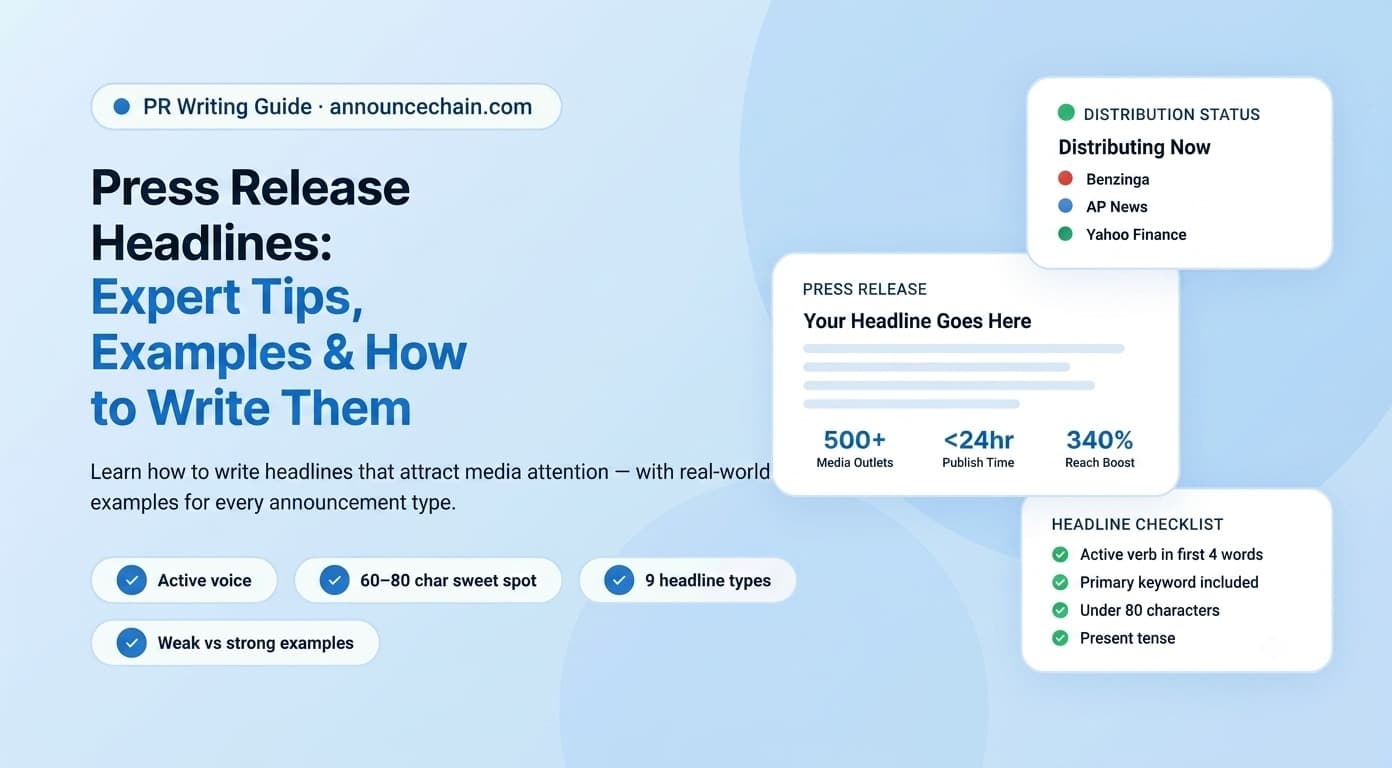
A press release headline is the first line of a press release and the single piece of copy that decides whether a journalist reads the rest of your news release or deletes it. It is a short, newsworthy statement, typically under 100 characters, built around one clear story: who did what, why it matters, and what changed.
A strong press release headline uses an active verb, a specific outcome, and the primary keyword your target audience searches for.
You can write a full press release with a powerful story, strong quotes, and a clear call to action, and it can still land in a journalist's trash folder. Nine times out of ten, the headline is why.
This guide covers press release headline writing from every angle: what makes an effective press release headline, which formats work for different announcement types, real-world examples you can adapt today, and the mistakes that cost companies media coverage every single day.
Key Highlights:
Journalists spend under 3 seconds on a headline. An attention-grabbing headline is the difference between a story that runs and one that gets ignored.
Press release headlines in the 51-75 character range earn the highest open rates, according to Cision. Longer headlines get cut off in email and search.
Every effective press release headline uses an active verb. "Company launches" beats "new product is being launched by company" every single time.
Product launches, acquisition press releases, charity events, new hire announcements, and PR crises each need a different headline structure.
What Makes a Press Release Headline Effective?
Every effective press release starts with an effective press release headline.
Here is the hard truth: most companies bury the news. They lead with the company name, add "is pleased to announce," and coast on jargon. Journalists have seen that opening thousands of times and they move on fast.
A great press release headline does three things at once.
It tells the story in one line.
It gives the reader a reason to care right now.
And it contains a key point the audience can act on or share.
That is the whole job.
According to a 2024 Cision study, press releases with headlines between 51 and 75 characters generate the highest journalist open rates. That is shorter than a tweet. Every single word needs to carry weight.
Here are the 6 core qualities of an effective press release headline and how to test each One:
Quality | What It Means | Quick Test |
Clarity | Anyone understands it in under 3 seconds | Read it aloud to a non-expert |
Newsworthiness | Something genuinely happened or changed | Ask "so what?" The answer must be obvious |
Specificity | Numbers, names, or outcomes anchor the claim | Replace vague words with concrete data |
Active Voice | Subject acts, not receives action | Cut any "is/are/was/were" opener |
Present Tense | Conveys immediacy and urgency | Swap past tense to present where possible |
Includes primary keyword naturally | Check what the top 3 results use |
Press Release Format: Where the Headline Fits
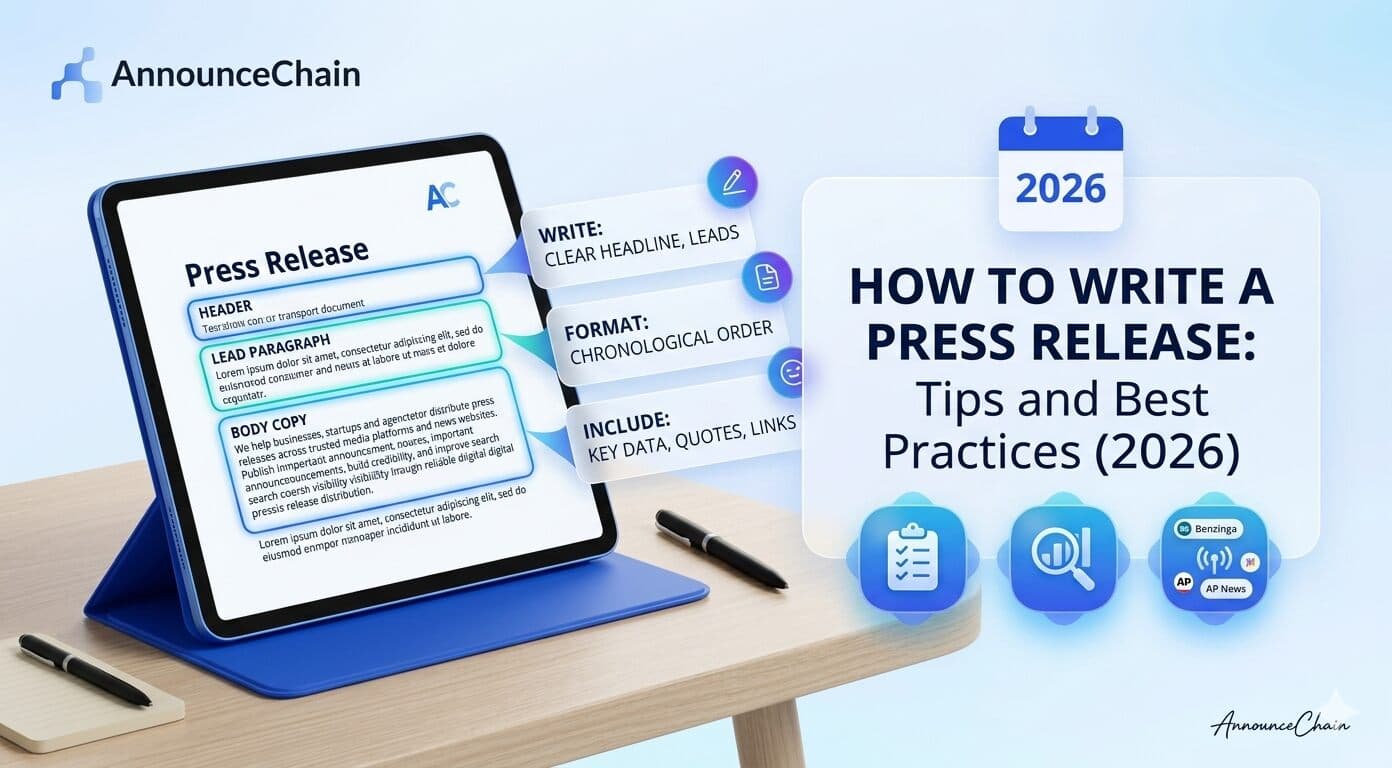
Understanding press release format helps you see why the headline carries so much weight. In a standard news release format, the headline sits at the very top of the page, directly below the contact information and release date.
Every element in a standard news release has a specific job, and when each one is done right, the whole release works together to get noticed. Here is how it all fits:
Headline (the first thing anyone sees, the only thing many read)
Dateline and opening paragraph (who, what, where, when, why in 40-60 words)
Body paragraphs (the full story, supporting quotes, key information, context)
Company boilerplate (the "about us" section at the bottom)
Media contact (name, email, phone, contact details so journalists can follow up)
Call to action (where to learn more, download a report, or register)
The first paragraph of a press release should be able to stand alone as a summary of the whole story. But the headline is what gets the first paragraph read at all.
If the headline fails, the rest of the release never gets a chance, no matter how many media outlets you distribute to.
One thing that trips up many press releases: writers treat the headline as an afterthought, written last and quickly.
Flip that habit.
Write your headline first, then build the rest of the announcement press release around it. The headline keeps your story focused.
Distribute Smarter From headline to delivery, Announce Chain makes press release distribution fast, affordable, and guaranteed.
No per-word fees. No vague delivery reports. Just confirmed reach to real media outlets across news networks, blogs, and industry publications.
9 Types of Press Release Headlines With Real World Examples
Not all press releases carry the same kind of news, and the headline format should reflect that. Whether you are starting from scratch or working from press release templates, each headline type is built around a specific communication goal. The most effective ones cut straight to the core story, deliver clear value to the reader, and never rely on clickbait to earn attention.
Here are the 9 most common types, with press release examples for each.
1. Product Launch Headlines
The best product launch headlines focus on what the product does for the customer, not on the product itself. Lead with the transformation, not the feature.
Strong: "AnnounceChain Launches Blockchain PR Tracker That Confirms Journalist Pickup in Under 60 Minutes".
Weak: "Company X Is Pleased to Announce the Release of Its New Software Product".
The weak version has no story. The strong version tells you exactly what changed and why it matters.
2. Product Updates
When an existing product gets a major improvement, treat it like a new launch. Name the update, name the benefit, name the number.
Example: "Company X 3.0 Adds Real-Time Journalist Matching, Cutting Average Distribution Time by Half"
3. Announcement Press Release Headlines
General announcement press releases cover expansions, new offices, and strategic decisions. Keep them concrete: where, what scale, what it enables.
Example: "XYZ Opens Asia-Pacific Hub in Singapore, Doubling Regional Distribution Reach"
4. Acquisition Press Release Headlines
For an acquisition press release, name both companies and state the combined impact. Two company names in one headline double credibility.
Example: "ABC Acquires PRSignal to Build the Largest Independent Press Release Distribution Network in North America"
5. Partnership Press Release Headlines
A partnership press release headline needs to answer: what does the partnership create that neither company could build alone?
Example: "XYZ and ABC Partner to Deliver Real-Time Coverage Analytics to 20,000 Content Marketers"
6. New Hire Press Release Headlines
New hire announcements get ignored unless the headline names the person, their new role, and a relevant credential.
Example: "XYZ Appoints Former Reuters Bureau Chief as VP of Media Relations"
7. Charity Press Release Headlines
A charity press release or charity event announcement needs a human impact number. How many people benefited? How much was raised? Make the good press release headline about the outcome, not the organization.
Charity press release example: "XYZ Foundation Raises $450,000 at Annual Gala, Funding Digital Literacy Programs for 3,000 Students"
8. PR Crisis Headlines
PR crisis headlines are the hardest to write because the instinct is to soften. Do the opposite. Direct acknowledgment builds more trust than careful language.
Example: "XYZ CEO Directly Addresses Thursday's Service Outage and Commits to 99.9% Uptime SLA"
9. Data-Driven Statistical Headlines
Statistics in headlines do two things: they attract media attention from journalists who need a hook, and they signal credibility to search engines.
Example: "Study: 78% of Journalists Open Press Releases with a Statistic in the First Line"
Example: "ABC Reports 10,000 Press Releases Distributed in Q1, Up 67% Year Over Year"
How to Write a Press Release Headline Step by Step?
Writing an effective news release headline requires balancing journalist appeal with search engine optimization. Most headline writing guides tell you to "be clear and compelling." That is not a process, that is a wish.
Here is an actual step-by-step method that works for every announcement type.
Step 1: Write the core fact in plain language
In one sentence, state what happened, who did it, and what changed. Do not edit. Just get it down: "Our company raised $5 million to expand into three new markets."
Step 2: Identify the primary keyword
What would your target audience type into a search engine? For most releases, this is your announcement type: "product launch press release," "acquisition press release," "new hire announcement." Pick one.
Step 3: Find the active verb
Replace any form of "to be" or "to announce." Try: launches, secures, appoints, reveals, expands, partners, acquires, commits, reports. Active voice is non-negotiable in headline writing.
Step 4: Add a number or specific outcome
Even one figure anchors the story. "$5M," "three markets," "67% growth," "1,200 attendees." Specifically, it is interesting. Vague is not.
Step 5: Use present tense
Present tense creates immediacy. "Company Secures $5M" reads faster and hits harder than "Company Has Secured $5M."
Step 6: Cut to 60-80 characters
Count every character. If you are over 80, cut an adjective. If you are over 100, cut a clause. The key information fits.
Step 7: Apply the "so what" test
Read the headline out loud and ask: so what? If you have to explain why it matters, the headline is not done. Rewrite until the value is self-evident.
Step 8: Run an A/B variant
Announce Chain lets you test headline variants and track open rates. Write a second version with a different angle, then let performance data guide the next release.
Press Release Headline Examples by Announcement Type
The fastest way to sharpen your instincts is to look at best press release examples side by side.
Here are weak and strong versions across the most common announcement types.
Every strong version follows the same rules: active verb, specific outcome, present tense, and a clear story.
Announcement Type | Weak Headline | Strong Headline |
Product Launch | Company X Is Pleased to Announce New Software | Company X Launches AI Tool That Builds a Full Press Release in 90 Seconds |
Product Updates | Version 3.0 Now Available for All Users | XYZ 3.0 Adds Journalist Matching, Cutting Average Send Time by 50% |
Acquisition | Company Completes Acquisition | ABC Acquires PRSignal to Create Largest Independent PR Distribution Network |
Partnership | Two Companies Sign Partnership Agreement | XYZ and ABC Merge Data Feeds, Giving Marketers Real-Time Coverage Maps |
New Hire | Company Welcomes New Executive | XYZ Appoints Former Reuters Bureau Chief as VP of Media Relations |
Charity Event | Annual Gala Raises Funds for Good Cause | XYZ Foundation Raises $450,000, Funding Digital Literacy for 3,000 Students |
PR Crisis | Company Responds to Recent Reports | CEO Addresses Thursday Outage Directly, Commits to 99.9% Uptime and Full Refunds |
Funding Round | Company Raises Series B Funding | EdTech Startup Secures $8M Series B to Launch in 12 New Markets by Q4 |
Company Event | Annual Conference Registration Now Open | 1,200 Content Marketers Expected at ABC PR Summit, June 2026, London |
Notice what every strong version has in common: a subject, an active verb, and a specific result. None of them say "is pleased to announce."
None of them lead with the company name followed by a long description. They lead with the news.
One quick note for small businesses: you do not need a famous brand name for an attention-grabbing headline.
The news is the hook.
An acquisition press release from a 12-person startup can outperform a vague announcement from a Fortune 500 company if it leads with a specific outcome and a real story.
Start Distributing Put This Into Practice with Announce Chain
Announce Chain gives every user headline performance data, confirmed delivery to thousands of media outlets, and the fastest guaranteed distribution available at any price point.
No hidden fees. No enterprise contracts. Fast, affordable, and built for companies of every size.
Common Mistakes That Kill Media Attention
Many press releases never get read because the headline breaks one of these rules.
These are the most common errors across many press releases that fail to attract media attention, even when the news itself is worth covering.
Passive voice
"New product is being launched by Company X" is immediately weaker than "Company X Launches New Product." Active voice is faster, clearer, and more attention-grabbing. This is not a stylistic preference, it is a mechanical improvement.
Burying the news
The most newsworthy element belongs in the headline, not in the second paragraph. If you are writing "we are excited to share that..." you have buried the story. Start over with the actual announcement.
Vague superlatives with no data
"World-class," "revolutionary," and "industry-leading" say nothing without proof. Replace them with the specific number or outcome that justifies the claim. Journalists will not invent the proof for you.
Ignoring character count
A headline that gets truncated in email previews or search engine snippets loses its entire message. Keep to 60-80 characters. Test it in a browser tab before you distribute.
Not using present tense
Past tense headlines feel like old news. Present tense creates immediacy. "Company Secured $5M" reads as done. "Company Secures $5M" reads as right now.
Missing the media contact
This is not a headline issue but it costs press releases every day. A perfect headline gets a journalist interested, and then they cannot find the contact details to follow up. Always include a full media contact section with name, email, and phone.
No call to action or next step
The headline raises awareness. The release converts it. Make sure the body includes a clear call to action, whether that is a product demo link, a registration page, or a media contact for an interview.
Trying to raise awareness without targeting
Broad distribution alone does not raise awareness with the right audience. The best headline in the world needs to go to the right media outlets, trade publications, and journalists for the relevant industry. Targeting matters as much as writing.
Ignoring social media amplification
A press release does not live only on wire services. After distribution, the headline and first paragraph should be adapted for social media posts across LinkedIn, X, and your company page. Media coverage compounds when journalists who missed the initial release encounter it through social channels later.
Before You Hit Send: Press Release Quality Check
Use this before every distribution. Grouped by stage so nothing gets missed.
Headline
Headline is 60 to 80 characters, hard max 100
Primary keyword appears in the first four words
Active voice and present tense throughout
At least one specific number, name, or measurable outcome included
Tested in mobile preview with nothing truncated
Body
Subheadline adds context without repeating the headline
First paragraph stands alone as a complete news summary
Passive voice eliminated, no "is pleased to announce" anywhere
Media contact section includes full name, email, and phone number
Call to action links to a specific page, not a homepage
Distribution
Headline language matched to your target industry and audience
A/B variant prepared so performance data improves your next release
How AnnounceChain Helps You Write and Distribute Your Press Release?
Writing a press release from scratch is where most companies lose time. Announce Chain's experienced PR team handles the entire process from crafting a headline that journalists actually open, to writing a release that tells your story clearly and professionally.
Every release goes through a team that has spent years understanding what editors want, what wire services prioritize, and what makes a story get picked up versus ignored. That experience is built into every draft they touch.
Distribution works the same way. AnnounceChain sends your release to verified, top-tier media outlets. A product launch goes to different publications than a crisis statement or an award announcement. The team handles that targeting so your release lands in front of the right journalists every time.
Conclusion
A strong press release headline follows three rules without exception: active voice, present tense, and at least one specific number or outcome. Break any of them and journalists move on. Keep all three and your story has a real chance of getting picked up.
Write the headline first, not last. It keeps your release focused and your story clear from the first word to the final paragraph.
When the writing is done, distribution decides the reach. Announce Chain's PR team writes releases that journalists want to read and delivers them to media outlets that actually matter - so your announcement doesn't just go out, it gets covered.
Frequently Asked Questions
What should a press release headline include?
A strong press release headline needs three elements: a clear subject (the company, person, or product), an active verb (launches, secures, appoints, reports), and a specific outcome or figure. It should be under 100 characters, written in present tense, and contain the primary keyword your target audience searches for. That is all the key information a headline needs to carry.
What is the difference between a press release and a news release?
They are the same document. "News release" is the older, more traditional term used in broadcasting and wire services. "Press release" became dominant in digital media. Both refer to an official announcement sent to journalists and media outlets to generate coverage. On most press release distribution platforms, including AnnounceChain, you will see both terms used interchangeably.
How long should a press release headline be?
The optimal length for a press release headline is 60-80 characters. Research from Cision and PR Newswire puts the highest open rates in the 51-75 character range. The hard maximum before headlines get cut off in email previews and search engine results is 100 characters. AnnounceChain's headline editor shows you a live character count so you hit the target before you distribute.
How do I write an effective press release headline for a product launch?
For a product launch press release, lead with what the product does, not what it is. Use the format: "[Company] Launches [Product Name] That [Solves Specific Problem] for [Target Audience]." Add a number if you have one. Example: "AnnounceChain Launches PR Distribution Tool That Confirms Journalist Pickup in Under 60 Minutes." Distribute through Announce Chain and use the built-in analytics to track which headline variant drives more opens.
How do I write a charity press release headline?
A charity press release headline should lead with impact, not with the organization's name. How much was raised? How many people benefit? Use a charity press release example format: "[Organization] Raises $[Amount] at [Event], Funding [Specific Program] for [Number] People." The specific number is what makes it a story. Without it, editors have nothing to publish and nothing to share.
What is a good press release headline during a PR crisis?
Crisis management headline writing requires speed and directness above everything else. Use the format: "[Company] [Addresses/Apologizes for/Commits to fixing] [Specific Issue], [Specific Action Taken]." Avoid hedging words like "allegations" or "reports." Name the problem and name the response. A PR crisis headline that sounds defensive will be read as an excuse. One that sounds direct will be read as leadership.
Does Announce Chain work for small businesses?
Yes, and it was built with small businesses in mind. Most enterprise distribution services like PR Newswire charge per word and per distribution tier, making them expensive for companies without large PR budgets. AnnounceChain offers flat-rate, affordable pricing with guaranteed delivery to relevant media outlets, real media contact access, and blockchain-verified receipts confirming your release was actually distributed. You get the same reach without the enterprise price tag. See current plans at announcechain.com/pricings.
Does a press release help with brand awareness and public relations?
A well-distributed press release is one of the most cost-effective public relations tools available, especially for companies without a dedicated marketing agency. Every time a journalist picks up your story and publishes it, you earn earned media, which builds brand awareness more credibly than paid advertising. Over time, a consistent press release strategy builds a body of coverage that potential customers, investors, and partners find when they search for your company. AnnounceChain tracks every pickup so you can see exactly how much brand awareness each release generates.
What is the difference between Announce Chain and other press release distribution services?
Most distribution platforms charge per word, offer uncertain delivery, and give you a PDF receipt that tells you nothing meaningful. AnnounceChain is different in three ways: guaranteed delivery to verified media outlets confirmed with blockchain receipts, real time journalist matching so your announcement press release goes to relevant editors (not just a mass list), and flat-rate pricing with no hidden costs. It is the fastest and most affordable way to distribute a press release effectively and actually verify it reached its destination.
What contact details should a press release include?
Every full press release needs a media contact section at the bottom. Include: the spokesperson's name, their title, a direct email address, a phone number, and your company website. Some releases also include social media handles. The contact info section is not optional. A journalist who reads your release and wants to follow up will move on to the next story if they cannot reach someone immediately.