Press release SEO is the process of writing and distributing news releases in a way that helps your brand show up in search results, earn media coverage, and build online authority at the same time.
In 2026, media releases are no longer just announcements. They are powerful SEO assets that can rank on Google, generate quality backlinks, and put your brand in front of the right audience at the right time.
Most guides will tell you to add keywords and call it a day. This guide goes deeper. You will learn exactly how press release SEO works in 2026, what mistakes to avoid, which platforms actually deliver results, and how to write a seo media release that search algorithms or engines and journalists both love.
If you want your news to rank, get picked up by real media, and bring qualified traffic back to your website, you are in the right place.
Let us get started.
Key Highlights:
A press release tells your story. SEO makes sure people can find it. Together, they help your organization get seen, get cited, and get visited.
Press release submission puts your announcement in front of news aggregators, media outlets, and Google all at once. You write it, best PR distribution platforms distribute it, and search platforms index it.
Writing a great SEO press release comes down to five things. Research your keywords, write a headline that ranks, place your keyword early, add clean backlinks, and include images with alt text.
One news release can rank in search, earn media coverage, and get cited by AI platforms like Google and ChatGPT long after the announcement goes live.
Keyword stuffing, bad links, and wrong anchor text can all hurt your rankings. Always link to a landing page, track traffic in Google Analytics, and measure impressions in Google Search Console.
What is Press Release SEO?
Press Release SEO (Search Engine Optimization) is the practice of writing and optimizing news announcements so search platforms, journalists, and readers can easily find them. It uses keywords, proper structure, and valuable backlinks to boost rankings and drive traffic back to your website.
In 2026, press release (PR) SEO is more important than ever. Discovery engines and AI tools like ChatGPT, Claude and Google Gemini no longer just crawl keywords, they look for trust, authority, and proof that real sources are talking about you. A well-optimized news release gives you exactly that.
Press Release or News Release SEO is important for four main reasons including feeding AI search platforms, earning high authority backlinks, boosting E-E-A-T and trust signals and driving qualified traffic.
Traditional Press Release Vs SEO Press Release
Traditional Press Release | SEO Press Release |
Earns media coverage and informs journalists | Ranks in search results and drives organic traffic |
Written for journalists, editors, and broadcasters | Written for discovery engines, AI tools, and online readers |
No keyword strategy, focuses on narrative flow | Keywords placed in headline, subheads, and opening paragraph |
Rarely includes links, just media contact info | Includes 1 to 3 natural backlinks to key website pages |
Text-heavy, follows AP Style and Inverted Pyramid | Multimedia-rich with images, videos, and meta tags |
Sent directly to newsrooms and media contacts | Distributed via platforms like Announce Chain and PR Newswire |
Press Release (PR) SEO sits where traditional media meets digital discovery. A well-optimized news release does three things at once: ranks in search, earns media coverage, and builds long-term brand authority that AI tools and lookup engines actually trust.
To make it work, you have to use researched keywords naturally in your headline and opening, add one or two clean and valuable backlinks to relevant pages, include images with alt text, and distribute through trusted platforms like Announce Chain and PR Newswire to ensure search platforms index every word.
A well-optimized press release ranks in search, earns media coverage, and builds long-term brand authority that AI tools and search algorithms actually trust.
Do Press Releases Help SEO?
Yes. Press releases help SEO in several meaningful ways, but not in the way many people assume it directly boosts organic search rankings. Instead, the real SEO benefits come indirectly through generating brand mentions, driving referral traffic, and securing high authority backlinks when journalists pick up your story.
Google has been clear that media release links distributed through wire services are not treated as traditional editorial backlinks. However, the SEO value of a well-executed press release goes much deeper than link equity.
Any link inside a distributed media release must use the rel="nofollow" attribute, according to Google's Link Schemes Guidelines. This means those links in press releases do not pass PageRank and will not directly improve your search rankings.
The real SEO benefits of a press release is not in the wire service link itself. It is in the earned media, brand signals, and organic discovery that a well-crafted, well-distributed release creates over time.
The Role of Press Releases in Digital PR
Press release SEO is the intersection where traditional media or public relations meet search platform discoverability. In the broader digital marketing landscape, optimized press releases act as foundational assets, providing structured, indexable data that fuels online visibility, triggers earned media coverage, and drives long term organic traffic.
Three Ways Press Releases Fit into Digital PR Strategy:
1. Amplifying Search Discoverability
By targeting specific, high-intent keywords in headlines and body copy, press releases rank in search tools and news aggregators like Google News. This puts your announcement directly in front of audiences actively searching for those topics. This is the core of SEO digital PR working in practice.
2. Building Entity Authority
Search engines today evaluate brands as much as they evaluate websites. Distributing well-structured, factual news about your brand, including images, video, and your NAP details, builds digital trust. This organized, consistent data is what AI answer engines use when deciding whether to reference your brand as a credible source in their responses.
3. Catalyzing Earned Media
The true SEO value of a press release often comes from what happens after PR distribution. Journalists, bloggers, and industry analysts regularly discover press releases through organic search and use them to write original articles. Those articles naturally yield highly authoritative press release links back to your site, making press release SEO link building one of the most powerful public relations strategies available for off page authority.
How to Write a Press Release for SEO?
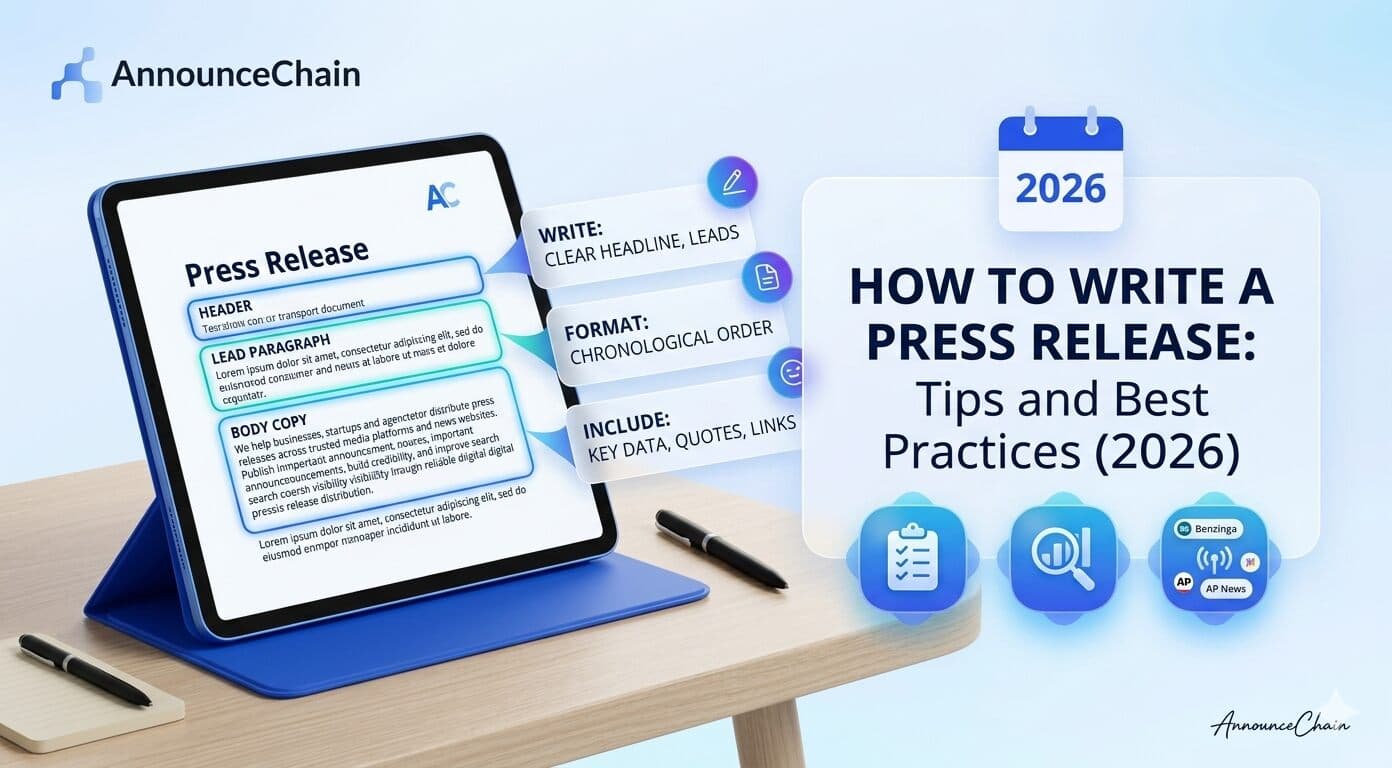
Writing a press release for SEO is not about stuffing keywords into a template. It is about crafting a structured, newsworthy announcement or press release content that both human readers and search engines can understand, trust, and share. Follow this framework every time.
Step 1: Start with Keyword Research
Use tools like Semrush, Ahrefs, or Googles Webmaster to find one primary keyword and two to three supporting terms. Focus on phrases your audience actually searches for and that match the topic and intent of your announcement.
Step 2: Write a Headline That Works in Search
The headline in press release writing is your single most important SEO element. Include your focus keyword, keep it under 70 characters, and lead with the news. Avoid vague or generic language that grabs attention and tells readers exactly what the announcement is about.
Step 3: Write a Powerful Lead Paragraph
Answer who, what, when, where, and why within the first 60 words. Place your primary keyword inside the first 50 words. Search platforms weigh the opening paragraph heavily, so get straight to the news with no background filler.
Step 4: Build the Body with Supporting Keywords
Expand the story with facts, quotes, and key details. Weave secondary keywords in naturally using H2 and H3 subheadings to guide readers. Never force a keyword into a sentence. If it does not read naturally, rewrite until it does.
Step 5: Include Strategic Backlinks
Add one to three links in press releases maximum and use natural, descriptive anchor text. Link only to pages on your site that are directly relevant to the announcement. Avoid keyword-stuffed anchor text as it carries risk and reads poorly to both users and Google.
Step 6: Add a Strong Boilerplate
Write 75 to 100 words describing your company. Include your primary industry keyword, a link to your homepage, and consistent NAP information. A strong boilerplate reinforces your brand entity signals across every release you publish.
Step 7: Optimize Your Multimedia
Include at least one high-quality image with descriptive, keyword-rich alt text. Add video if available. Rich media increases dwell time, improves engagement signals, and makes your release eligible for Google Discover and rich result features.
How to Use Keywords Effectively?
Keywords in a news release should feel natural, not forced. Placing the right keywords or most important search terms in the strategic locations like in the meta title, title, headings, and URLs while keeping the content natural without making the writing feel forced or robotic.
Placing the right terms in the right spots maximizes your SEO efforts, helping both readers and search platforms immediately understand what your announcement is about.
Target one primary keyword and two to three supporting terms. Put your primary keyword in the headline, the opening paragraph, and at least one subheading. Let supporting keywords appear naturally throughout the body without repeating them just to hit a count.
Prioritize long-tail keywords. Phrases like "best media release distribution service" attract smaller but far more engaged audiences than broad single-word terms. They also face less competition and convert better.
When adding links, use natural anchor text that describes where the link goes. Avoid stuffing keywords into anchor text. A clean, descriptive link builds trust with both the reader and Google.
Not sure how to write it yourself? Let AnnounceChain's expert PR writers craft your press release and get it right the first time.
How to Optimize a Press Release for SEO?
Writing a press release and optimizing a press release are two different things. Optimization is the layer of technical and strategic decisions that determine whether your release gets indexed, ranked, and discovered.
To optimize a press release for SEO, always focus on keyword-rich headlines, natural keyword placement, and contextual linking. Here is how to approach it systematically:
Keyword Placement Strategy
SEO for press releases follows a clear keyword placement hierarchy. Your focus keyword belongs in the headline, the first sentence of the lead paragraph, one subheading in the body, and the anchor text of at least one backlink. Secondary keywords should appear naturally in the body copy without repetition.
Meta Description Optimization
When distributing through platforms that allow meta descriptions, write a custom meta description of 150 to 160 characters. Include your primary keyword in the first half of the description. This is what appears in search results and directly influences click-through rate.
URL and Title Tag
If your press release lives on your own website or a platform that allows custom URLs, use a clean, keyword-rich slug. For example, press-release-seo-guide-2026 is stronger than release-00234-final-v2. The title tag should match your headline and include your focus keyword. This is a basic standard that any reputable marketing agency applies before a release goes live.
Internal Linking
If you publish an effective press release on your own website, treat them as content assets and link to them from related blog posts, product pages, and resource sections. Internal links pass authority and help search tools discover and index your release faster.
Schema Markup
Advanced press release SEO optimization includes adding NewsArticle schema markup to releases published on your own domain. This structured data tells Google exactly what your content is, who wrote it, when it was published, and what it is about. It dramatically improves your chances of appearing in Google News and AI-powered search features.
What Is Press Release Submission in SEO? How the Distribution Process Actually Works?
Press release submission in SEO is the process of distributing your optimized news release through online platforms that syndicate content to search tools, news aggregators, and media outlets. It is how your release gets indexed and discovered beyond your own website.
The distribution process works in a clear sequence. You write and optimize your press release, choose a distribution platform, submit the release through their system, and the platform syndicates it to its network of partner publications, news sites, and search algorithms. Google then crawls and indexes the release, making it searchable by anyone looking for that topic.
Once your release is live, three things can happen.
First, it appears directly in search results for your target keyword.
Second, journalists and bloggers who discover it organically write articles that link back to your website.
Third, AI platforms like Google Gemini and Perplexity may cite your release in their AI-generated answers, giving you a new form of visibility that no paid ad can buy.
This is why news release distribution tools for SEO selection matters. Not all platforms are equal. The best press release services for SEO offer indexable pages, SEO-friendly formatting, multimedia support, and analytics that show you how your release performed.
The Best News Release Services for SEO in 2026
Choosing the best news release distribution platform is one of the most important decisions in your press release SEO strategy. The platform determines how widely your release is syndicated, whether it gets indexed by Google, and what kind of analytics you can access.
Service | Key Strength | Best For |
Guaranteed PR distribution across 500+ media outlets with SEO backlinks and transparent reporting | Best for businesses of all sizes seeking maximum online visibility, top search rankings, and unmatched PR distribution | |
Premium syndication, Google News indexing, massive reach | Best for established brands and major announcements | |
Strong financial and investor coverage, global distribution | Best for corporate and investor relations releases | |
SEO-focused features, affordable tiers, solid analytics | Best for startups and growing brands | |
Budget-friendly, good SEO indexing, fast turnaround | Best for small businesses and local SEO | |
Full PR suite, journalist database, deep analytics | Best for agencies and enterprise PR teams |
For businesses that want guaranteed results, AnnounceChain delivers press release distribution across 500+ media outlets, powerful SEO backlinks, and clear transparent reporting at a price that works for every budget. Announce Chain offers the strongest search engine optimization press release distribution networks.
PR Newswire and Business Wire are trusted by large brands for their wide reach and strong media networks. Both platforms offer solid SEO distribution but are best suited for businesses with larger budgets.
For startups and growing businesses with tighter budgets, Newswire and EIN Presswire deliver solid SEO value at a lower cost.
Whichever platform you choose, confirm that it provides a publicly accessible, indexable URL for your release. If the platform hides your release behind a login wall or does not allow discovery engine crawling, your SEO PR efforts will be wasted.
Ready to get your press release in front of 500+ media outlets? Start your guaranteed PR distribution with AnnounceChain today.
The Importance of SEO in Press Release Strategy
Integrating SEO to your media release turns a simple announcement into a high-impact digital asset. Most PR teams treat press releases as one-time announcements. They write, distribute, and move on. This is the single biggest reason most brands leave enormous amounts of traffic, authority, and media coverage on the table.
A press release is not just a news announcement. When treated as an SEO asset, it becomes a long-term traffic driver, a backlink catalyst, a brand entity signal, and a piece of content that AI platforms reference for months or years after publication.
Here are the four pillars of press release SEO strategy:
Pillar 1: Search Visibility
Every PR you publish is an opportunity to rank for a keyword your competitors are not targeting with their website content. Product launches, executive hires, partnership announcements, and industry reports all carry search intent from journalists and consumers.
Pillar 2: Off-Page Authority
Press release off-page SEO refers to the authority signals generated when your release earns coverage from external publications. Each earned article that links back to your site improves your domain authority, diversifies your backlink profile, and strengthens your overall search presence.
Pillar 3: Brand Entity Trust
In 2026, Google and AI platforms evaluate brands as entities, not just websites. Consistent, factual press releases that include your brand name, location, industry, key people, and website build the entity profile that query engines and AI tools use to determine how credible and authoritative your brand is.
Pillar 4: Co-Occurrence
When your brand name appears next to industry keywords, discovery engines start connecting your business with those topics. The more this happens, the easier it becomes for people to find you online.
News Release SEO Mistakes That Kill Your Rankings (And How to Fix Them)
Press releases can help your website rank higher. But if you misuse them just to trick Google, they can actually hurt your rankings.
Even experienced PR professionals make critical SEO errors that prevent their press releases from ranking, earning media, or building authority. Here are the most common mistakes and exactly how to fix each one:
Treating Syndication as a Link-Building Strategy
Using press releases just to build hundreds of backlinks does not work. Search platforms recognize syndication networks and ignore or devalue those links. Focus on reach and brand awareness instead and let natural links come on their own.
How to Fix:
Focus on brand reach, not backlinks
Let journalists find and link to you naturally
Think PR first, SEO second
Keyword Stuffing Headlines and Body Text
Forcing keywords into every line makes your release sound robotic and spammy. Search platforms penalize this and readers stop reading. A PR should sound like news, not an ad packed with search terms.
How to Fix:
Use your keyword once in the headline
Add LSI keywords naturally in the body
Always write for humans first
Using Manipulative Anchor Text
Linking phrases like "best cheap software" or "buy now" looks unnatural to Google. It signals manipulation and can hurt your rankings fast. Anchor text should feel like a natural part of the sentence.
How to Fix:
Use your brand name as anchor text
Keep it natural
Avoid overly optimized phrases
Linking to Your Homepage Instead of a Landing Page
Sending readers to your homepage after a specific announcement confuses them. They cannot find what you promised and leave quickly. This hurts both conversions and SEO signals.
How to Fix:
Link to a dedicated landing page
Match the page to your announcement topic
Make it easy for readers to take action
Forgetting to Track and Measure Success
Publishing and forgetting is a common mistake. Counting how many sites picked up your release is not a real measurement. You need to know if real people visited your site and if your rankings improved.
How to Fix:
Track referral traffic in Google Analytics
Monitor keyword impressions in Google Search Console
Measure results, not just placements
Conclusion
Press release SEO is not a shortcut or a hack that gives you instant results. It is a disciplined, strategic approach to making your news announcements work harder, reach further, and last longer than a traditional press release ever could.
In 2026, the brands that win in search are the ones treating every press release as a dual-purpose asset: a news announcement for journalists and an SEO asset for Search platforms and AI platforms. They research their keywords before writing, structure their releases for readability and indexation, distribute through trusted platforms, and follow up to capture earned media coverage.
The framework in this guide covers everything from what news release SEO is to how to write it, optimize it, distribute it, and avoid the mistakes that silently kill rankings. Use it as your reference every time you publish a release.
Start with one press release. Apply the keyword research, follow the structure, choose a reputable distribution platform, and measure the results. The difference between a media release that disappears and one that ranks, earns backlinks, and gets cited by AI tools is not luck. It is execution.
Frequently Asked Questions
How many press releases per month is good for SEO?
One to four press releases per month is ideal for most businesses. Consistency matters more than volume. Publishing one well optimized release every week builds steady authority, improves brand online visibility, and keeps your name appearing in search results regularly.
Why do we do press release submission in SEO?
Press release submission helps your announcement get indexed by Google, syndicated across media outlets, and discovered by journalists. It builds brand authority, generates referral traffic, and creates backlink opportunities that strengthen your overall search presence over time.
What is press release in off page SEO?
In off page SEO, an effective press release builds authority signals outside your website. When journalists pick up your release and link back to your site, those earned backlinks improve your domain authority and strengthen your overall search engine rankings.
Do press releases work for SEO?
Yes. Press releases generate brand mentions, referral traffic, and earned backlinks when distributed correctly. They also build entity trust with Google and AI platforms. The key is writing for real news value, not just to gain links or manipulate rankings.
Are press releases good for SEO?
Yes. Effective press releases improve SEO by generating authoritative backlinks, increasing brand mentions, and driving referral traffic. They also strengthen your E-E-A-T signals, which Google uses to determine how credible and trustworthy your brand is in search results.
Is investing in a news release distribution service worth it?
Yes, if you choose the right platform. A good distribution service gets your release indexed by Google, placed on high authority media outlets, and seen by real journalists. The earned media and backlinks generated can deliver SEO value for months or years.
Is SEO dead or evolving in 2026?
SEO is evolving, not dying. In 2026, search tools and AI platforms prioritize trust, authority, and entity signals over simple keyword matching. Press releases play a key role in building those signals and keeping your brand visible across both traditional and AI powered search.
What is the 80/20 rule for SEO?
The 80/20 rule in SEO means 80 percent of your results come from 20 percent of your efforts. For press releases, this means focusing on high quality newsworthy content, strong keyword placement, and trusted distribution platforms rather than publishing large volumes of low quality releases.