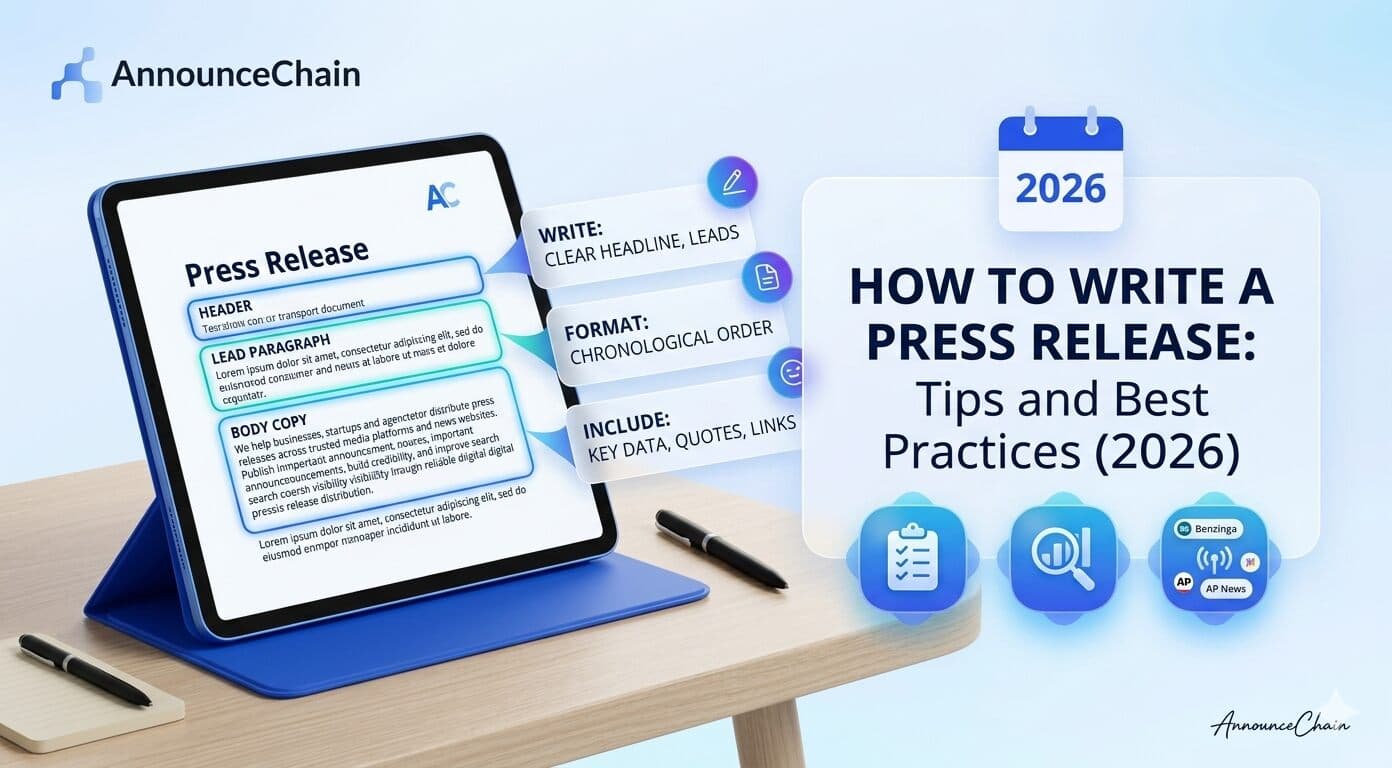
A press release is a short written statement issued by a company’s public relations department that companies use to broadcast or spread information, knowledge or ideas through media channels to reach both the general public and journalists.
It is one of the most powerful tools a company needs to reach the media. It helps businesses share important news quickly, clearly, and professionally to the general public.
Whether you are a startup announcing your first product or an established organization sharing quarterly earnings, the news release remains the standard format for public communication.
This guide covers everything you need to know about press releases in 2026. You will learn what they are, how they work, how to write one, and how to get real results from them.
Key Highlights:
A press release is an official written statement that companies send to journalists and media outlets to share important news.
Press releases serve as a direct communication tool between organizations and the media, helping to shape public perception and build brand credibility.
A press release works by a company distributing it to media outlets, where journalists review it and decide whether to cover the story, publish it as-is, or ignore it.
A well-written press release follows a clear structure: headline, dateline, lead paragraph, body, boilerplate, and media contact.
What Is a Press Release?
A press release is an official news announcement or information that companies share with journalists and the general public to announce something important about the company. This could be a startup announcing its first product or a tech company announcing a strategic merger or acquisition. It gives reporters everything they need to cover the story.
A press release is also known as a news release, media release, press statement, or public notice. These terms all mean the same thing and are used interchangeably depending on the industry or region.
Companies use press releases to share important news with the media and the public. Whether it is a new product launch, a merger, an executive appointment, or an earnings report, a press release helps businesses get media coverage, control how their story is told, and build credibility with their audience.
Press releases are typically handled by a company's public relations department or an outside PR firm. Once written, they are distributed through newswire services that push the content to thousands of newsrooms, websites, and journalists all at once.
The goal of a press release is simple. It informs the public, engages the media, and builds credibility. When done right, journalists notice the news and write their own stories about it.
How a Press Release Works?
A press release works by a company writing an announcement and sending it through a newswire service to journalists and newsrooms. Reporters read it and decide if it is worth covering. If it is worth covering, they write a story. That is how one announcement can reach millions of people at once.
Here is how the process works step by step:
Step 1: The Company Writes the Announcement
A press release starts inside the company. The public relations team or a hired PR firm drafts the announcement. Every word is intentional. The goal is to present the news in the most accurate and compelling way possible while staying completely factual and professional.
Step 2: It Goes Through an Internal Approval Process
Before a press release goes public, it is reviewed and approved internally. Legal teams check for compliance. Executives review the messaging. This step protects the company from errors, miscommunication, and legal risk. Nothing gets sent out until every word is signed off.
Step 3: It Is Distributed Through a Newswire Service
Once approved, the press release is pushed out through a newswire service such as PR Announce Chain, Newswire, Business Wire, or GlobeNewswire. These platforms distribute the content directly to journalists, editors, and digital media outlets across the world within minutes of publishing.
Step 4: Journalists Review and Decide
Reporters and editors receive the press release and evaluate it. They ask one question. Is this worth covering? If the news is strong, timely, and relevant to their audience, they move forward. If it is not, it gets skipped. The quality of the press release makes all the difference here.
Step 5: The Story Gets Written and Published
A journalist who finds the news credible writes an independent story based on the press release. That story then gets published on their platform. This is where the company earns media coverage it did not pay for. That kind of coverage carries far more trust than any paid advertisement.
Step 6: The News Reaches the Public
Once published, the story spreads. It appears on news websites, Google News, social media feeds, and industry publications. The original press release has now turned into widespread public awareness. That is the full cycle of how a press release works from start to finish.
One Thing to Always Remember: A press release is written by the company, not by a journalist. It represents the company's point of view. Readers and reporters should always approach it with that in mind. The best press releases are honest, clear, and easy to verify.
What Is the Purpose of a Press Release?
The primary purpose of a press release is to share important and newsworthy information through media channels to attract the attention of journalists and the general public.
It gives journalists accurate and ready-to-use facts about significant company updates. When the information is clear and trustworthy, journalists are more likely to pick it up and turn it into a full story. That is exactly what a press release is designed to do.
The core purpose of a press release is:
To inform the media
Journalists receive hundreds of pitches every week. A well-formatted press release gives them everything they need in one place. It saves them time, makes their job easier, and increases your chances of getting covered.
To share material information
Publicly traded companies are legally required to disclose certain information to the public. Press releases are one of the main channels used for this. Earnings announcements, executive changes, and major deals all fall into this category.
To control the narrative
When something big happens, companies need to speak first. A press release lets you define the story before anyone else does. It keeps your message clear, accurate, and on your terms.
To build brand credibility
Regular press releases show that your company is active and growing. Over time, media coverage builds trust with customers, investors, and the public in a way that paid advertising simply cannot.
To improve online visibility
Press releases published on newswires get picked up by Google News and other digital platforms. This drives traffic, earns backlinks, and helps your company rank higher in search results.
To attract investors
Investor relations teams use press releases to share financial results, growth milestones, and strategic updates. It keeps shareholders informed and signals that the company is transparent and moving forward.
Structure of a Good Press Release
A good press release is built on the inverted pyramid method. The most important information leads at the top, followed by supporting details, and then background context at the bottom. It stays between 400 and 600 words, fits cleanly on one to two pages, and is formatted in a way that makes it easy for any journalist to scan and understand within minutes.
The essential components of a good press release are organized in the following order:
1. Release Status & Contact Info
At the very top of every press release, you will find the words "FOR IMMEDIATE RELEASE" or an embargo date. This tells editors exactly when they are allowed to publish the news. It is a small detail that carries a lot of weight in the PR industry.
2. Headline
The headline is the most important line in your press release. It is the first thing a journalist sees and the last chance you have to make them keep reading. Keep it under 100 characters. Be specific. Lead with the news. A weak headline gets ignored. A strong headline gets covered.
3. Subheadline (Optional)
A subheadline is a single line that supports the headline without repeating it. It adds context and gives the journalist a reason to read further. Not every press release needs one but when used correctly it makes the opening stronger.
4. Dateline
The dateline appears at the start of the lead paragraph. It includes the city and the date the news originates from. For example: NEW YORK, May 8, 2026. It signals to journalists that the news is current and relevant right now.
5. Lead Paragraph
This is the most critical paragraph in the entire press release. It must answer the five W's. Who is involved? What happened? When it took place. Where it occurred. And why it matters. Write this paragraph as if it is the only thing the journalist will read. Keep it under 60 words and make every word count.
6. Body Paragraphs
The body is where you expand on the announcement. Add supporting facts, data points, and background context that help journalists understand the full story. Keep each paragraph short. Two to four sentences is the right length. Long paragraphs lose attention fast.
7. Executive Quote
Every strong press release includes a direct quote from a company leader. This adds authority and a human voice to the announcement. Avoid generic statements like "We are excited to announce." Say something specific, meaningful, and substantive. A great quote gives journalists something worth printing.
8. About the Company (Boilerplate)
The boilerplate is a short paragraph of three to five sentences that describes your company. It appears at the bottom of every press release you publish. It should cover your mission, key offerings, location, and website. Write it once, keep it updated, and reuse it consistently across all releases.
9. Media Contact Information
This section is essential. Include the full name, job title, email address, and phone number of the person journalists should contact for follow up. Without this information, a journalist who wants to cover your story has no way to reach you. That means a missed opportunity every single time.
10. End Marker
Three pound signs centered at the bottom of the page signal the end of the press release. It looks like this: ###
This is standard practice across the entire PR industry. It tells the editor that there are no additional pages and that the release is complete.
How to Write a Press Release?
To write a press release that gets noticed, start with a strong headline that leads with the news. Use the inverted pyramid structure mentioned above. Open your lead paragraph with the five W's. Who is involved, what happened, when it took place, where it occurred, and why it matters.
From there, add supporting details, an executive quote, and your company boilerplate. Keep it between 400 and 600 words and make every sentence earn its place.
Your headline is the first thing a journalist sees. Make it specific, clear, and newsworthy. If it does not grab attention in the first second, the rest of the press release will not get read.
Your lead paragraph carries the entire story. Write it as if it is the only paragraph the journalist will read. Cover all five W's and keep it under 60 words. Every word must serve a purpose.
Your body paragraphs add the detail and context that support the main announcement. Keep each paragraph short and focused. Include data, quotes, and facts that give journalists everything they need to write their own story confidently.
Your executive quote adds authority and a human voice to the announcement. It should come from a company leader and say something specific and meaningful. A strong quote gives journalists something worth printing and makes the story feel real.
Always end with your boilerplate and media contact information. The boilerplate tells journalists who your company is. The contact details give them a direct line to follow up. Without both, even the best press release leaves journalists with unanswered questions.
What Are the Types of Press Releases?
Not all press releases are the same. Different situations call for different types. The most common types of press releases include product launch press releases, earning press releases, executive appointment press releases, partnership press releases, crisis press releases, and event press releases.
Each type serves a specific purpose, so here is a closer look at what makes them different.
Product Launch Press Release: Announces a new product or service. It focuses on what the product does, who it is for, and when it will be available. It often includes pricing and a link to learn more.
Earnings Press Release: Shared by publicly traded companies after each financial quarter. It includes revenue, earnings per share (EPS), year-over-year comparisons, and commentary from company leadership. Stock prices often move significantly after these releases.
Executive Appointment Press Release: Announces a new hire or leadership change. It includes the person's background, their new role, and a quote from both the new executive and existing leadership.
Merger and Acquisition Press Release: Announces that two companies are joining forces or that one is acquiring another. These releases are closely watched by investors and analysts.
Partnership Press Release: Announces a strategic collaboration between two organizations. It explains what each party brings to the partnership and what the combined effort will achieve.
Crisis Press Release: Issued when something goes wrong. A product recall, a data breach, a legal dispute. The goal is to get accurate information out quickly and show that the company is responding responsibly.
Event Press Release: Announces an upcoming event such as a conference, product demonstration, or community initiative. It includes the date, location, agenda highlights, and registration details.
Award or Recognition Press Release: Shares news that the company or one of its leaders has received an award, certification, or industry recognition.
Press Release Mini Case Study
A press release works best when you see it in action. Below is a hypothetical example of a company that used a single press release to launch a product, earn media coverage, and win enterprise clients. No agency. No ad spend. Just a clear announcement sent to the right people.
Summary
XYZ is a SaaS company that builds productivity tools for remote teams. When they launched their flagship product ABC, they had no media presence and no industry recognition. They needed coverage fast. They turned to Announce Chain to distribute their product launch press release and get their news in front of the right audience.
The Challenge
ABC was ready. The product solved a real problem. Remote teams across the country were struggling to manage projects, track deadlines, and collaborate across time zones. XYZ had built a smarter way to do it. But the team had zero recognition in the SaaS space. Bigger competitors dominated search results and industry publications. The marketing team knew that without coverage the launch would be invisible. They had no PR agency and no budget for paid advertising.
The Approach
XYZ wrote a focused one-page product launch press release. It named the exact problem their customers faced every day. It explained what ABC did and how it worked. It included a quote from the CEO and a quote from a beta user managing a fully remote team of 80 people. They used Announce Chain to distribute it across 400 plus trusted media outlets including AP News, Business Insider, and Benzinga. The press release went live in under 24 hours with no back and forth and no delays.
The Results
Two major SaaS industry publications ran the story within five days. A leading software review platform followed shortly after. Website traffic jumped 310 percent in the first two weeks. Demo requests climbed from 8 per month to 74. Three enterprise clients signed contracts within 60 days. XYZ did not outspend its competitors. It simply showed up with the right message and used the right platform to make sure it reached the right people.
A clear press release sent through the right distribution platform made all the difference for XYZ. It did not require a big budget or a PR agency. It required a focused message and a reliable way to get it out.
Example of a Press Release
A press release follows a specific structure for a reason. Journalists receive dozens of pitches every day. A well-structured press release makes it easy for them to find the key information fast and decide whether to cover the story.
Below is a complete ready-to-use example of a Earnings Press Release and Product Launch Press Release. Read it once to understand the format. Then use it as your own starting point.
Example 1: Earnings Press Release
FOR IMMEDIATE RELEASE
[Company Name] Reports Q1 2026 Revenue of $2.4 Billion, Up 38% Year-Over-Year
Enterprise segment drives growth; company raises full-year guidance
[CITY], May 8, 2026 — [Company Name] (NASDAQ: [TICKER]) today reported financial results for the first quarter ended March 31, 2026. Total revenue reached $2.4 billion, representing a 38% increase compared to Q1 2025. Earnings per share came in at $1.84, exceeding analyst consensus estimates of $1.67.
"Our enterprise division delivered exceptional results this quarter," said [Name], Chief Executive Officer of [Company Name]. "We are seeing strong demand across all markets, and we are raising our full-year guidance to reflect this momentum."
The company expects Q2 2026 revenue of $2.5 to $2.6 billion, with full-year revenue guidance revised upward to $9.8 billion from the previous estimate of $9.2 billion.
About [Company Name] [Company Name] is a leading technology solutions provider serving enterprise clients in over 60 countries. Founded in 2001 and headquartered in [City], [Company Name] helps organizations improve operational efficiency through cloud infrastructure, data analytics, and AI-powered tools. For more information, visit [www.companywebsite.com].
Media Contact: [Name], VP of Communications press@companywebsite.com | +1 (XXX) XXX-XXXX
Example 2: Product Launch Press Release
FOR IMMEDIATE RELEASE
[Company Name] Launches SmartDesk Pro, an AI-Powered Workspace Tool for Remote Teams
New platform reduces meeting time by up to 40%, available starting June 1, 2026
[CITY], May 8, 2026 — [Company Name] today announced the launch of SmartDesk Pro, a new AI-powered workspace management platform designed to help distributed teams collaborate more efficiently. The product is available starting June 1, 2026, with pricing beginning at $29 per user per month.
SmartDesk Pro uses machine learning to analyze team workflows, automate scheduling, and reduce redundant meetings. In beta testing with 500 enterprise users, participants reported a 40% reduction in weekly meeting time.
"Remote work is here to stay, but productivity tools have not kept pace," said [Name], Chief Product Officer at [Company Name]. "SmartDesk Pro is built specifically for how people work today."
SmartDesk Pro integrates with Slack, Microsoft Teams, Google Workspace, and Zoom. A 30-day free trial is available at [www.companywebsite.com/smartdesk-pro].
About [Company Name] [Boilerplate description of the company goes here.]
Media Contact: [Name], VP of Communications press@companywebsite.com | +1 (XXX) XXX-XXXX
When to Issue a Press Release (and When Not To)?
Issue a press release when your company has a genuine, verifiable announcement: a new product, a merger, a leadership appointment, a major award, or a crisis statement. But strong news alone is not enough.
Timing decides whether your release gets covered or ignored. Send on Tuesday through Thursday, between 5–9 am or 10 am–2 pm local time, when journalists are most receptive and actively planning their stories.
So how do you know if your announcement qualifies? Below is a clear breakdown of exactly when you should issue a press release, and when you should hold back.
When to Issue a Press Release?
Company milestones & growth: Launching a new product or service, announcing a rebrand, completing a merger or acquisition. These signal genuine company progress that the media can report on.
Events & conferences: Hosting, sponsoring, or speaking at a significant industry event. Use a three-release strategy: primary release 2–4 weeks before, a reminder 2–3 days before, and a recap afterward.
Leadership & executive changes: Hiring a new CEO, appointing key board members, or announcing significant staff expansions that signal organizational strength or strategic direction.
Crisis management: Issuing formal statements during an emergency or addressing a public issue, only when leadership and spokespersons are fully available for follow-up media interviews.
Awards & recognition: Winning a major industry award or achieving a top-tier certification that adds credibility and is relevant to your customers or industry peers.
When NOT to issue a press release
No spokesperson or leadership team is available to answer media questions immediately after release.
The news is a minor update, a small bug fix, an office repaint, or a routine policy tweak. Use a blog post, newsletter, or social media instead.
The content states opinions only, with no supporting data, statistics, or verified quotes from key stakeholders.
The announcement is strictly internal (e.g., a team offsite, internal restructure) and lacks relevance to customers, investors, or the public.
If the news only matters to your internal team, it is not press release material. A press release is for news that has meaning beyond your company walls.
Ideal timing strategy
Best days to send: Tuesday, Wednesday, and Thursday are the strongest days. Journalists are most active midweek. Monday releases compete with the backlog from the weekend. Friday releases get lost heading into the weekend.
Best time of day: Send between 5–9 am or 10 am–2 pm in the journalist's local time zone. Most reporters review their inboxes first thing in the morning.
Avoid: Major holidays, election days, and days when major industry news is expected to break. Your release will be buried.
Use this checklist before sending:
Is this news significant enough to warrant a press release?
Is the timing appropriate for the audience?
Is all the information accurate and legally approved?
Is the media contact listed and available to respond?
Has the boilerplate been updated recently?
Pros and Cons of Using a Press Release
The upside is real: earned coverage, stronger SEO, and a trusted public record. The downside is equally real: high costs and no guarantee anyone will publish it. Understanding both sides helps you decide when to send one and when to skip it.
Like a coin, a press release has two sides worth knowing before you send one.
Pros | Cons | |
Credibility | Earned media coverage builds far more trust than paid advertising | Only works if the news is genuine — forced credibility damages your brand |
Reach | Can reach thousands of outlets and regions in a single distribution | Reach means nothing if journalists do not find the story newsworthy |
SEO | High-authority backlinks boost search rankings and online visibility | Low-quality releases on spammy sites can actually hurt your SEO |
Cost | Free and low-cost distribution options exist for small businesses | Premium newswires like PR Newswire cost hundreds to thousands per release |
Control | You control the message, tone, and facts in the release itself | You cannot control how journalists interpret or reframe your story |
Coverage | Strong news with good timing can generate widespread earned media | There is no guarantee any outlet will pick up or publish your story |
Reputation | Consistent, quality releases build long-term media relationships | Frequent weak releases train journalists to ignore your brand entirely |
Press Release vs Press Conference vs Press Statement vs Media Alert: Key Differences
Press Release vs Press Statement
A press release tells a full story. It has context, background, quotes, and data. A press statement is reactive and brief. It addresses one specific issue. Companies issue press statements when they need to respond quickly to external events or media inquiries without releasing a full document.
Press Release vs Media Alert
A media alert is an invitation. It uses a simple format: who, what, where, when, why. Its only purpose is to get journalists to show up at an event. It does not tell the full story. The press release does that.
Press Release vs Press Conference
A press release is a document. A press conference is a live event. The biggest difference is interaction. Journalists can ask questions at a press conference. They cannot do that with a press release. Press conferences are reserved for high-stakes announcements where real-time dialogue matters.
Conclusion
A press release is one of the most established and trusted tools in public relations. Companies have used them for over a century to reach journalists and inform the public. That has not changed.
What has changed is how competitive the media landscape is. Journalists receive more pitches than ever. A mediocre press release gets ignored. A great one gets covered.
The formula for a great press release is straightforward. Start with genuinely newsworthy information. Follow the standard format. Write clearly and concisely. Distribute through the right channels at the right time. Follow up professionally.
When done correctly, a press release earns media coverage that builds credibility, drives traffic, and reaches audiences your advertising budget cannot reach.
Frequently Asked Questions
What should a press release contain?
A press release should contain a headline, dateline, lead paragraph, supporting body copy, an executive quote, a company boilerplate, and media contact details. The lead paragraph must answer Who, What, When, Where, and Why within the first three sentences.
How long should a press release be?
The ideal length is 300 to 500 words, with 400 words being the sweet spot. It should fit on one page. Anything longer risks losing a journalist's attention before they reach the most important details.
How to submit a press release?
Write your release, build a targeted media list, then distribute via a newswire service or direct email pitch. Send Tuesday through Thursday, early morning. Follow up once, two to three days later. Never send the same generic pitch to every journalist.
Is press release free?
Writing one is free. Distributing it costs money. Free services offer limited reach. Paid newswires like Announce Chain, PR Newswire or Business Wire range from $150 to over $1,000 per release. For real media coverage, paid distribution through a trusted newswire delivers significantly better results.
What are the 5 W’s in a press release?
The 5 W's are Who, What, When, Where, and Why. Every press release must answer all five in the opening paragraph. If a journalist reads only your first three sentences and still cannot understand the full story, the release will be ignored.
What qualifies as a press release?
An announcement qualifies as a press release when it is verifiable, newsworthy, and relevant to a public audience. Product launches, funding rounds, executive hires, mergers, major awards, and crisis statements all qualify. Internal updates, opinions, and minor changes do not.
What are the 7 types of PR?
The 7 types are media relations, community relations, crisis communications, employee relations, investor relations, public affairs, and social media communications. Each targets a different audience and serves a specific purpose within a company's overall communication strategy.